

01THE CLEANING REQUIREMENT
Start with what actually needs attention.
Start with a walk-through of the proposed areas and record the condition of each. Production floors, storage and circulation areas, accessible walls and structural surfaces, machinery-adjacent spaces, corners and floor edges may need different attention. Identify accumulated dust, debris or deposits rather than describing the requirement simply as a complete factory clean.
Ordinary housekeeping maintains recurring upkeep. Periodic intensive cleaning addresses selected build-up or detailed areas through a defined project. A marked plan, photographs or an area schedule can help operations, procurement and the cleaning team discuss the same requirement before comparing proposals.
Routine Housekeeping
- Regular upkeep.
- Defined recurring work areas.
- Day-to-day cleaning methods.
- Scheduled housekeeping routines.
Industrial Deep Cleaning
- Targeted intensive work.
- Specific deposits or surface conditions.
- Suitable specialist equipment.
- Work-zone planning and defined handover.
Deep cleaning should be scoped to the actual site condition, not assumed to include every surface or piece of equipment.
Confirm inclusions and exclusions explicitly. Identify which stock or movable materials must be cleared, whether elevated surfaces require separate assessment, and who prepares the work area. Machinery interiors, dismantling and sensitive installations should never be assumed to be included in a general deep-cleaning quotation. These boundaries influence both resources and commercial comparisons.
02OPERATING CONDITIONS
The cleaning plan must fit the facility.
Review the assignment alongside production, logistics and maintenance activity. Working production lines, vehicle and forklift routes, material movement and worker access can determine when an area becomes available. A quiet aisle at inspection may be busy during the proposed cleaning window; confirm the expected conditions with the responsible site personnel.
Identify electrical and mechanical installations, restricted-access areas and sensitive equipment near the work. Review machinery-adjacent access, worker movement and maintenance shutdown opportunities with responsible personnel. Access to a space does not by itself establish that cleaning can proceed alongside active equipment. The objective is to coordinate the plan with operations and reduce avoidable interference wherever practical.
| Site condition | Planning implication |
|---|---|
| Active production | Assess when work can safely take place |
| Material movement | Coordinate access and work-zone boundaries |
| Sensitive equipment | Confirm restrictions and suitable methods |
| Elevated structures | Assess access equipment and specialist requirements |
A continuously operating site may release individual areas in stages; another may offer a scheduled maintenance window. Confirm the expected conditions for the proposed dates, not only those observed during the initial visit. Record dependencies and a contact for operational changes rather than promising a universal schedule or zero disruption.
03METHODS & EQUIPMENT
Different surfaces demand different methods.
Select the method after reviewing the material, finish, contamination and available access. A technique suitable for one work area may be unsuitable for the next. Discuss coatings, nearby installations, drainage and material restrictions before deciding on resources; machine availability alone should not determine the cleaning approach.
- 01Mechanised Floor Cleaning
Used where flooring, access conditions and surface compatibility make mechanised cleaning suitable.
- 02Manual Detailing
Relevant to edges, corners and selected accessible areas requiring more controlled attention.
- 03Elevated Cleaning
May involve specialist access equipment, competent personnel and separately assessed working conditions.
- 04Deposit Removal
Requires consideration of material characteristics, substrate compatibility and suitable cleaning methods.
Where a finish or likely result is uncertain, an agreed sample area may help establish expectations. Permanent stains, corrosion or damaged surfaces may remain after cleaning. Clarify those limitations and obtain appropriate technical guidance where needed. Stronger treatment should not be treated as a substitute for understanding the surface and its condition.

04EXECUTION PLANNING
Organise the work before it starts.
Divide a larger assignment into defined work zones. Agree on boundaries, access, equipment movement and stock-clearance responsibilities with site personnel. Identify who can release each zone, who supervises cleaning and who receives an issue affecting the plan. The sequence should follow the areas that are genuinely ready for work.
- 01Prepare the Area
Confirm access, clearance responsibilities and applicable precautions.
- 02Coordinate the Work
Agree on suitable sequencing and communication with the facility team.
- 03Review Progress
Identify outstanding observations and adapt within the agreed scope.
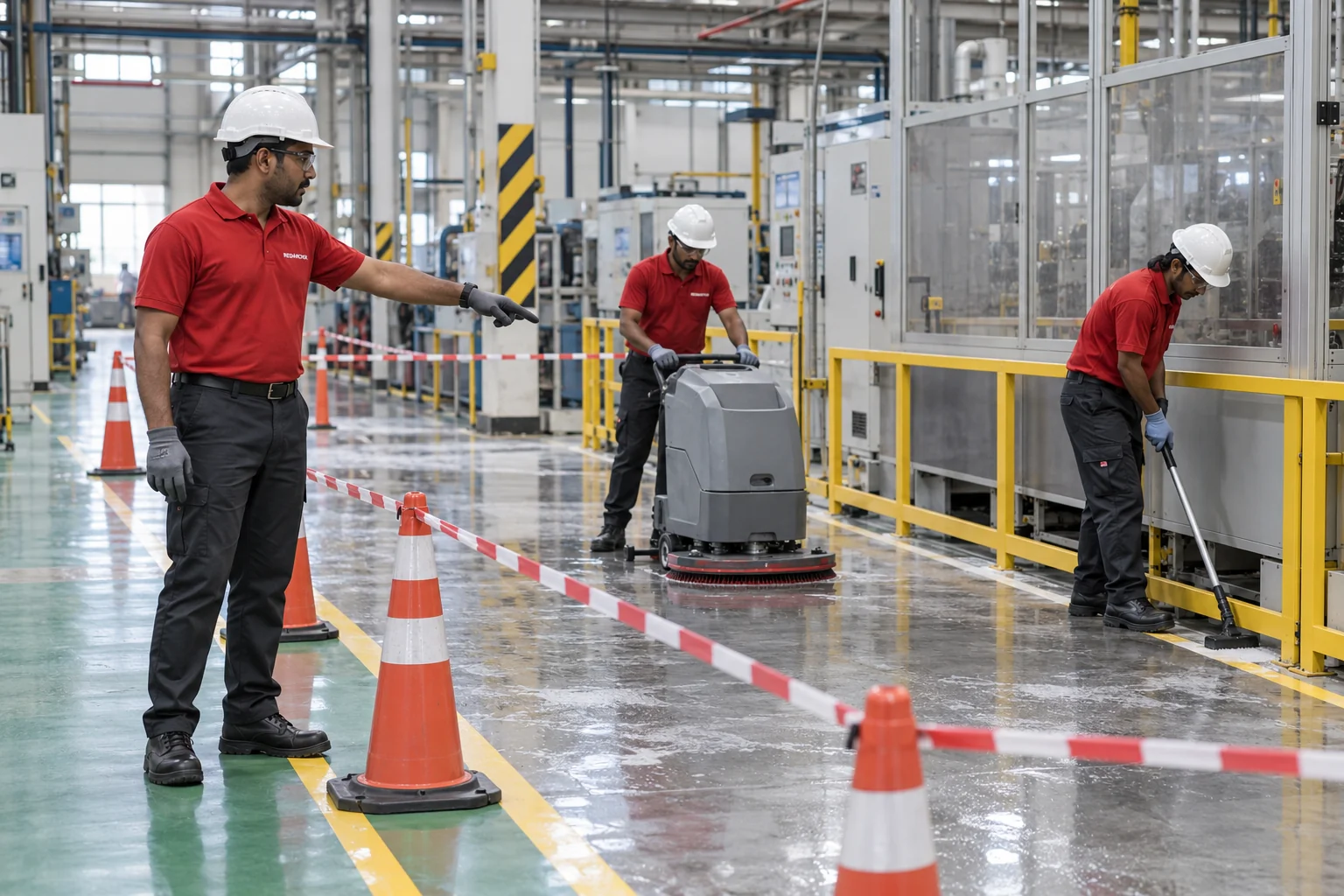
Cleaning contractors and the facility's responsible personnel should establish precautions for the intended work. Requirements depend on site risks, equipment, access arrangements and applicable procedures. Confirm suitable PPE, supervision and communication; temporary wet areas or equipment may require controlled entry. Elevated work and equipment-related hazards require competent, site-specific assessment.
Use a practical progress discussion to review upcoming dependencies. If stock has not moved or production priorities change, reassess the affected work before continuing. Keep usable routes and the next handover point clear. A schedule should remain connected to site conditions rather than become an instruction to proceed regardless of changes.
05COMPLETION & HANDOVER
A completed project needs a clear review.
Agree on the completion criteria before execution. The review should relate to the quoted work areas and tasks, using suitable visual inspection and any other agreed checks. Discuss surface limitations, inaccessible sections and exclusions so an undefined expectation of absolute cleanliness does not replace the actual scope.
Nominate a client representative for review and clarify the required handover records. Record outstanding observations, limitations encountered and any additional work that requires separate agreement. Where completion documentation is needed, settle the format in advance. The handover conversation should distinguish completed cleaning from permanent stains, damaged finishes or other conditions that the agreed method cannot resolve.
A useful handover confirms what was completed against the agreed scope—not an undefined promise that every mark or defect will disappear.
06PRACTICAL CHECKLIST
Eight questions before approving the work.
- 01
Which areas and surfaces are included?
- 02
What site conditions could affect the work?
- 03
Are production or material movements restricted?
- 04
Who will clear stock or movable materials?
- 05
Are sensitive equipment areas excluded?
- 06
Which working windows and access arrangements are appropriate?
- 07
Who will supervise and review progress?
- 08
How will completion and handover be assessed?
A better-defined scope makes a better starting point.
Industrial deep cleaning is easier to plan when the work areas, operating conditions, suitable methods and completion expectations are understood before mobilisation.
A site-specific assessment can then help determine the resources, sequencing and commercial scope appropriate to the assignment.
Source note
Cleaning — UK Health and Safety Executive →
Further reading on floor-cleaning methods and temporary access controls. General practical reference; not a statement of Indian statutory requirements.